
7 Geometry Theorems That Appear in Nearly Every SASMO Paper
Geometry questions make up nearly 40% of every SASMO paper. Yet most students spend their prep time scattered across dozens of random topics instead of mastering the core theorems that actually show up year after year.
If you’re preparing for SASMO, you need a focused approach. The competition rewards students who can recognize patterns and apply foundational theorems under pressure. Memorizing formulas won’t cut it. You need to understand how these theorems connect and when to use each one.
SASMO geometry theorems form the backbone of competition success. Seven core theorems appear repeatedly: angle sum properties, triangle congruence, circle theorems, Pythagorean relationships, similar triangles, parallel line properties, and area relationships. Students who master these theorems and practice applying them in multi-step problems consistently outperform peers who try to memorize isolated formulas. Focus your preparation on recognizing theorem patterns in context.
Understanding what makes SASMO geometry different
SASMO doesn’t test textbook definitions. The competition wraps theorems inside creative scenarios that require you to spot which principle applies.
A typical question might give you a complex diagram with multiple triangles, circles, and parallel lines. You’ll need to identify which theorem unlocks the solution. That’s why isolated practice isn’t enough.
The exam writers deliberately combine multiple concepts in single problems. You might need to use the angle sum theorem to find one angle, then apply similar triangles to find a length, then finish with the Pythagorean theorem.
This layered approach separates strong students from exceptional ones.
The seven theorems that appear most frequently
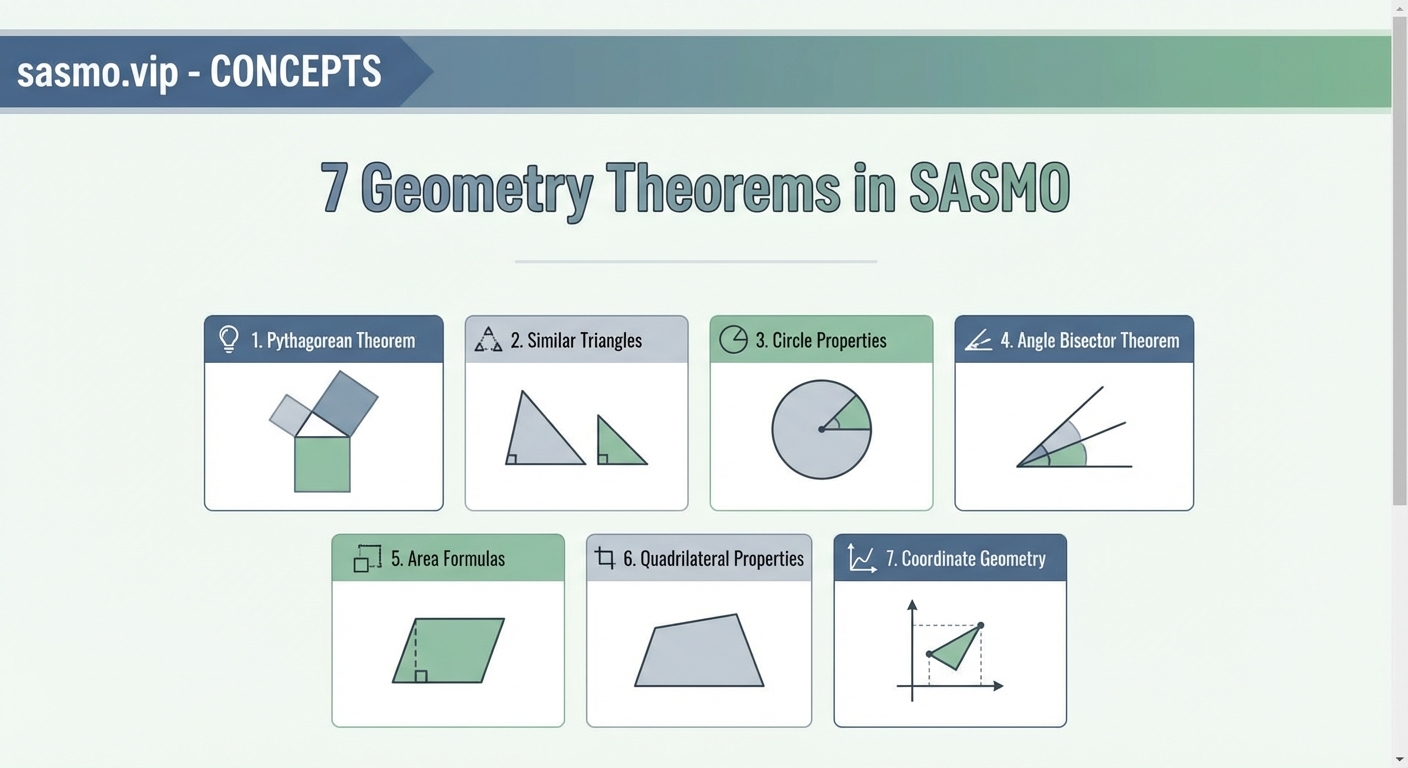
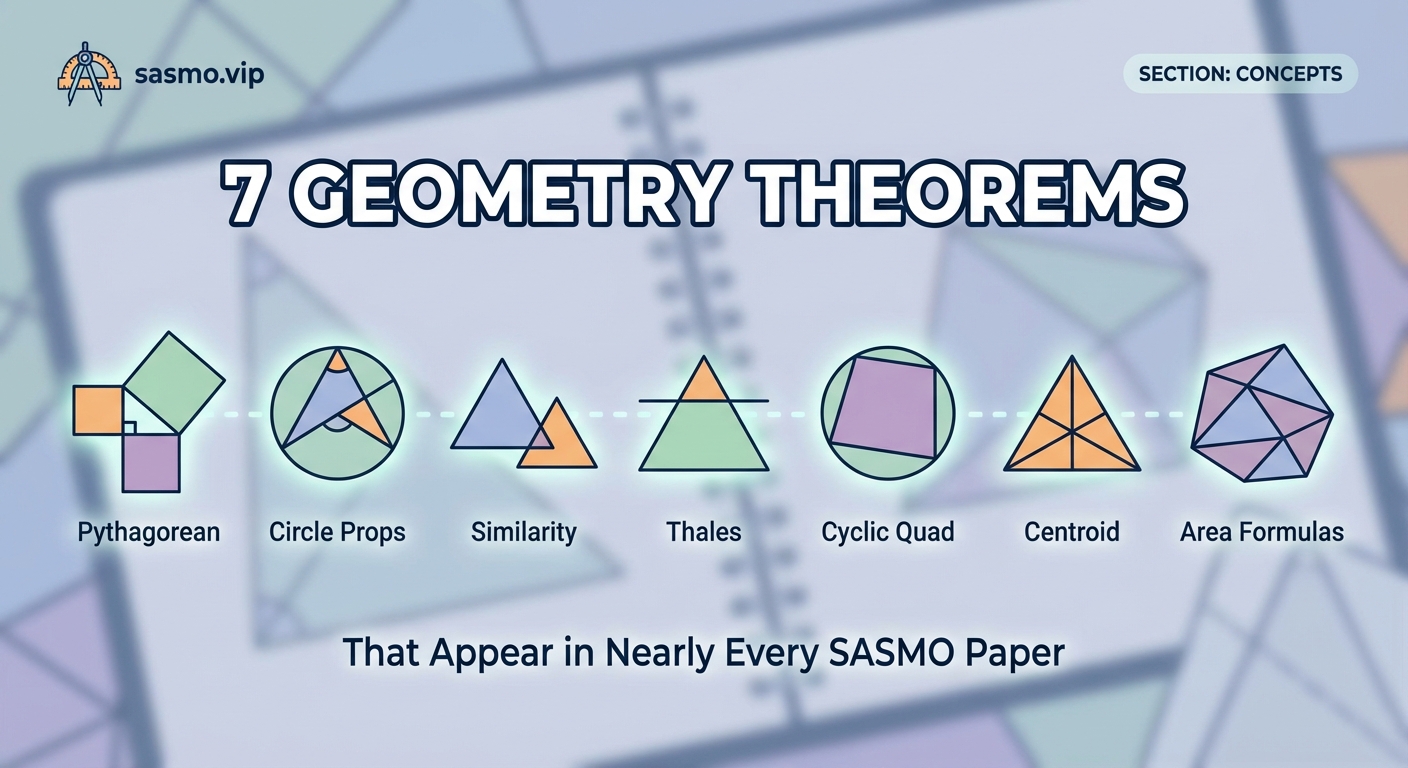
After analyzing past SASMO papers from 2015 to 2024, these seven theorems show up in nearly every competition:
1. Angle sum properties
Every triangle’s interior angles sum to 180 degrees. Quadrilaterals sum to 360 degrees. Polygons follow the formula (n-2) × 180 degrees where n equals the number of sides.
SASMO loves testing this with irregular polygons or by hiding triangles inside complex shapes.
2. Triangle congruence theorems
SSS (side-side-side), SAS (side-angle-side), ASA (angle-side-angle), and AAS (angle-angle-side) prove triangles are identical. RHS (right angle-hypotenuse-side) works for right triangles specifically.
Competition problems often require you to prove congruence before you can find missing measurements.
3. Circle theorems
Angles in the same segment are equal. The angle at the center is twice the angle at the circumference. Tangents from an external point are equal in length. The angle in a semicircle equals 90 degrees.
SASMO papers frequently combine multiple circle theorems in elaborate diagrams.
4. Pythagorean theorem and extensions
For right triangles: a² + b² = c². The competition extends this to Pythagorean triples (3-4-5, 5-12-13, 8-15-17) and tests whether you can spot them without calculating.
You’ll also see problems requiring the converse: if a² + b² = c², then the triangle is right-angled.
5. Similar triangles
Triangles are similar when corresponding angles are equal. Their sides are proportional. SASMO uses this for indirect measurement problems and nested triangle scenarios.
AA (angle-angle), SAS (side-angle-side with proportional sides), and SSS (all sides proportional) prove similarity.
6. Parallel lines and transversals
When parallel lines are cut by a transversal, corresponding angles are equal, alternate interior angles are equal, and co-interior angles sum to 180 degrees.
These properties often appear as setup steps for more complex proofs.
7. Area relationships
Triangles with the same base and height have equal areas. The ratio of areas of similar figures equals the square of the ratio of corresponding lengths.
SASMO frequently asks you to find areas without giving you all measurements directly.
How to apply theorems in multi-step problems
Recognizing a theorem is step one. Applying it correctly under time pressure requires practice with this systematic approach:
- Draw or redraw the diagram clearly with all given information marked.
- List what you know and what you need to find.
- Identify which theorem connects the known information to the unknown.
- Write down the theorem statement before applying it.
- Show each calculation step to avoid arithmetic errors.
- Check if your answer makes geometric sense.
Most students skip steps three and four. They jump straight to calculations and lose track of their reasoning.
Writing the theorem name creates a mental checkpoint. It forces you to confirm you’re using the right tool before investing time in calculations.
Common mistakes that cost competition points
| Mistake | Why It Happens | How to Avoid It |
|---|---|---|
| Assuming angles are right angles | Diagrams aren’t drawn to scale | Only use right angles when marked or proven |
| Mixing up congruence and similarity | The terms sound related | Congruent means identical; similar means same shape, different size |
| Forgetting to convert units | Questions mix centimeters and meters | Circle all units in the problem before starting |
| Using theorems that don’t apply | Rushing to finish | Check all conditions before applying a theorem |
| Rounding too early | Trying to save time | Keep exact values until the final answer |
The unit conversion mistake alone accounts for roughly 15% of preventable errors in SASMO geometry sections.
Building speed without sacrificing accuracy
Speed comes from pattern recognition, not from working faster. When you’ve solved 50 similar triangle problems, you spot the setup instantly.
Here’s how to build that recognition:
- Solve problems by theorem type first, not by difficulty level.
- Time yourself on individual problems to identify which theorems slow you down.
- Review wrong answers immediately to understand which theorem you misidentified.
- Practice drawing auxiliary lines that reveal hidden triangles or parallel lines.
- Memorize common angle combinations (30-60-90, 45-45-90, isosceles triangles).
Students who can draw an auxiliary line to create a useful triangle often solve problems two minutes faster than peers who only work with given information.
“The best SASMO students don’t just know theorems. They see geometry problems as puzzles where each theorem is a tool. They ask themselves: which tool fits this situation? That mindset shift turns memorization into problem-solving skill.”
Practice strategies that actually work
Random practice wastes time. Focused practice builds competition skills.
Start with single-theorem problems until you can solve them in under two minutes. Then move to two-theorem combinations. Finally, tackle full competition-style problems that require three or more theorems.
Track which theorem types you consistently get wrong. If circle theorems trip you up, spend three focused sessions on just circles before moving on.
Use past SASMO papers, but solve them strategically:
- First pass: identify which theorems each problem requires without solving.
- Second pass: solve only the problems using your weakest theorems.
- Third pass: complete full papers under timed conditions.
This approach builds both recognition speed and calculation accuracy. You can apply similar focused strategies when learning why number theory is the secret weapon every SASMO competitor needs.
Connecting theorems to real competition scenarios
SASMO problems rarely state “use the Pythagorean theorem.” They describe situations where you need to recognize that the theorem applies.
A problem might describe a ladder leaning against a wall, or a rectangular garden with a diagonal path. You need to see the right triangle hidden in the scenario.
Similarly, circle theorem problems might involve wheels, clock faces, or pizza slices. The geometry is identical, but the context changes.
Practice translating word problems into geometric diagrams. This skill matters as much as knowing the theorems themselves.
When you encounter seemingly impossible problems, look for these common hidden structures:
- Isosceles triangles that create equal angles
- Cyclic quadrilaterals where opposite angles sum to 180 degrees
- Triangles sharing a common height
- Radii that create congruent triangles within circles
These patterns appear in at least 60% of challenging SASMO geometry questions. Once you spot them, the solution path becomes clear. For more advanced problem-solving techniques, check out 10 most challenging SASMO geometry problems and how to solve them.
Managing theorem knowledge on competition day
Knowing theorems matters less than accessing them under pressure. Competition anxiety makes students forget even basic principles.
Create a one-page theorem reference sheet during practice. Include:
- Theorem names and statements
- Quick diagrams showing when each applies
- Common variations or extensions
- One example problem for each
Review this sheet daily for two weeks before the competition. The repetition builds automatic recall.
On competition day, spend the first 30 seconds of the geometry section scanning all problems. Mark which ones look familiar based on diagram shape. This primes your brain to recognize patterns.
If you get stuck on a problem, move on after 90 seconds. Your subconscious will keep working on it. When you return, you’ll often see the solution immediately.
Time management skills complement theorem knowledge. Learn more about how to manage your time effectively during SASMO competition day.
Why theorem mastery beats formula memorization
Formulas give you answers. Theorems give you understanding.
When you understand why the angle sum of a triangle equals 180 degrees, you can reconstruct the proof if you forget. When you only memorize the formula, you’re stuck if anxiety makes you blank.
SASMO rewards understanding because the problems require adaptation. You can’t just plug numbers into formulas. You need to see how theorems relate to each other.
A problem might require you to prove two triangles are congruent, use that congruence to establish equal angles, apply those angles to prove lines are parallel, then use parallel line properties to find the final answer.
Each step depends on solid theorem knowledge. Memorized formulas can’t carry you through that chain of reasoning.
Building your theorem toolkit
Start your preparation at least three months before competition day. That gives you time to master each theorem deeply rather than cramming superficially.
Week 1-2: Master angle sum properties and basic triangle theorems. Solve 20 problems for each.
Week 3-4: Add triangle congruence and similarity. Focus on proving relationships before calculating.
Week 5-6: Tackle circle theorems with emphasis on combining multiple properties.
Week 7-8: Work on parallel lines and area relationships together since they often appear in the same problems.
Week 9-10: Solve full mixed problems that require identifying which theorem applies.
Week 11-12: Complete timed practice papers and review all mistakes.
This progressive approach builds confidence. You’re never overwhelmed because you’re adding one layer at a time.
Geometry theorems as your competition foundation
SASMO geometry isn’t about memorizing hundreds of facts. It’s about mastering seven core theorems so deeply that you recognize them instantly in any context.
The students who score highest don’t necessarily know more theorems. They know the essential ones better. They’ve practiced enough to see patterns immediately. They’ve made enough mistakes to know which assumptions to avoid.
Your preparation should mirror this approach. Focus on depth over breadth. Master these seven theorems until they become second nature. Build speed through pattern recognition, not rushed calculations. Check your work by asking whether the answer makes geometric sense.
Start with single-theorem problems today. Build to complex multi-step challenges over the coming weeks. Track your progress by timing yourself and reviewing mistakes immediately. The competition rewards students who prepare systematically, not those who cram randomly the night before.
These theorems will serve you long after SASMO. They form the foundation for advanced mathematics, engineering, architecture, and countless other fields. But right now, they’re your key to competition success.