
Combinatorics Made Simple: Counting Principles for SASMO Success
You’re staring at a SASMO problem that asks how many ways you can arrange five books on a shelf, or how many different routes exist from point A to point B. Your first instinct might be to start listing possibilities one by one. But there’s a smarter way. Understanding counting principles combinatorics transforms these seemingly complex questions into simple calculations that take seconds instead of minutes.
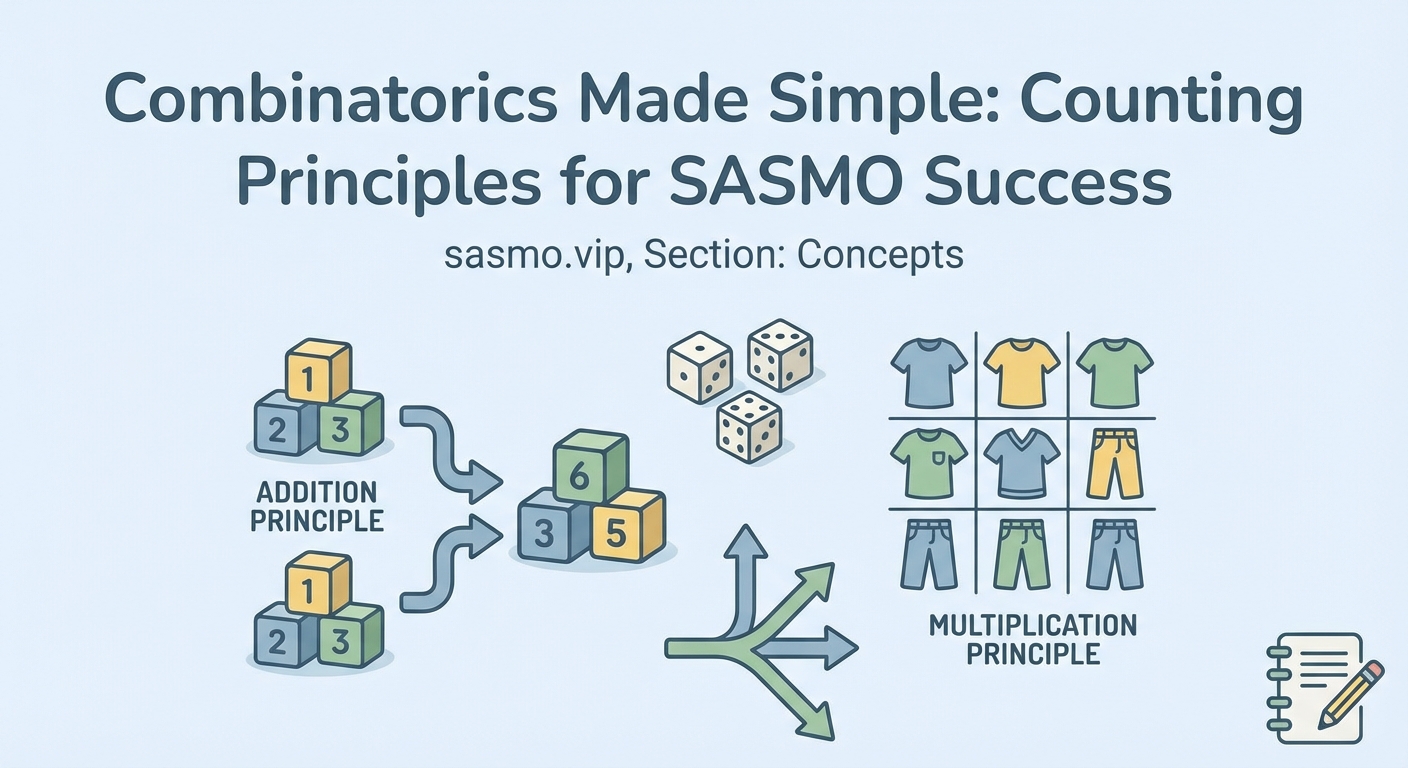
Counting principles combinatorics gives you two powerful tools: the multiplication principle for sequential choices and the addition principle for alternative options. These methods help you calculate possibilities without tedious listing. Master these foundations and you’ll solve SASMO counting problems with confidence, speed, and accuracy every time you face arrangement, selection, or pathway questions.
Why Counting Without Listing Changes Everything
Imagine counting every possible outcome by writing them all down. For small numbers, this works fine. But what happens when a problem involves choosing from 10 items, then 8, then 6? You’d need to list thousands of combinations.
That’s where counting principles step in. They let you calculate totals using multiplication and addition instead of exhaustive enumeration.
Think of it like this. If you need to travel from your house to school, then from school to the library, you don’t need to map every single route. You just multiply the number of paths between each location.
This approach saves time during competitions. More importantly, it prevents errors that creep in when you’re trying to track dozens of possibilities under pressure.
The Multiplication Principle Explained

The multiplication principle applies when you make choices in sequence. Each decision happens one after another, and the choices are independent.
Here’s the rule: if task A can be done in m ways and task B can be done in n ways, then both tasks together can be done in m × n ways.
Let’s use a concrete example. You’re creating a password that needs one letter followed by one digit. There are 26 letters and 10 digits (0 through 9).
How many passwords are possible? Multiply 26 by 10. You get 260 different passwords.
The key word here is “and.” When a problem says do this AND then do that, multiplication is your friend.
Real SASMO Application
A typical SASMO problem might ask: “How many three-digit numbers can you form using the digits 1, 2, 3, 4, and 5 if no digit repeats?”
Break it down step by step:
- Choose the first digit: 5 options
- Choose the second digit: 4 options (one digit is already used)
- Choose the third digit: 3 options (two digits are already used)
Multiply them: 5 × 4 × 3 = 60 three-digit numbers.
No listing required. Just logic and multiplication.
The Addition Principle Made Simple
The addition principle handles situations where you choose between different options. You pick one path OR another, but not both.
The rule: if event A can occur in m ways and event B can occur in n ways, and the two events cannot happen at the same time, then either A or B can occur in m + n ways.
The critical word here is “or.” When you see problems asking “in how many ways can you do this OR that,” think addition.
Here’s an example. You can travel to a competition venue by bus or by train. There are 3 bus routes and 2 train routes.
How many ways can you get there? Add them: 3 + 2 = 5 ways.
Notice that you can’t take a bus and a train at the same time for the same trip. The choices are mutually exclusive.
Combining Both Principles
Many SASMO problems require both principles working together. This is where students often stumble, but the logic stays consistent.
Consider this: You need to form a committee of one president and one secretary. You can choose the president from 4 students in class A or 3 students in class B. The secretary must come from a different group of 5 students.
First, handle the “or” situation for the president: 4 + 3 = 7 ways to pick a president.
Then, for each president choice, you have 5 secretary options.
Multiply: 7 × 5 = 35 different committees.
Common Mistakes and How to Avoid Them
Students make predictable errors when applying counting principles. Recognizing these mistakes helps you sidestep them during competitions.
| Mistake | Why It Happens | How to Fix It |
|---|---|---|
| Adding when you should multiply | Confusing “or” with “and” scenarios | Ask: do events happen in sequence or as alternatives? |
| Forgetting to account for restrictions | Overlooking “no repeats” or “must be odd” conditions | Highlight restrictions before calculating |
| Double counting | Counting the same outcome through different paths | Check if choices are truly mutually exclusive |
| Ignoring order | Treating arrangements as selections | Determine if ABC differs from CBA in context |
Let me show you a tricky one. How many ways can you select 2 class representatives from 5 students?
If you think 5 × 4 = 20, you’ve double counted. Choosing Amy then Ben is the same as choosing Ben then Amy when order doesn’t matter.
The correct approach here moves beyond basic counting principles into combinations, but recognizing when order matters is part of mastering these foundations.
Building Your Problem-Solving Process
When you face a counting problem during SASMO, follow this systematic approach:
- Read the problem twice and identify what you’re counting
- Determine if choices happen in sequence (multiply) or as alternatives (add)
- Check for restrictions like “no repeats” or “must be even”
- Calculate step by step, showing your work
- Verify your answer makes logical sense
Let’s apply this to a sample problem: “How many four-letter codes can you create using A, B, C, D, E, F if the first letter must be a vowel and letters can repeat?”
Step 1: We’re counting four-letter codes.
Step 2: Each position is a sequential choice, so we’ll multiply.
Step 3: First position has a restriction (vowels only: A or E). Other positions have no restrictions.
Step 4: Calculate:
– First letter: 2 choices (A or E)
– Second letter: 6 choices (any letter, repeats allowed)
– Third letter: 6 choices
– Fourth letter: 6 choices
– Total: 2 × 6 × 6 × 6 = 432 codes
Step 5: Does 432 make sense? Yes, because we have limited first choices but many options afterward.
The secret to mastering counting principles isn’t memorizing formulas. It’s training yourself to see the structure of a problem: what happens first, what happens next, and what restrictions apply at each step.
Practice Problems That Build Confidence
Nothing beats working through problems yourself. Here are scenarios you might see on SASMO papers:
Problem A: A restaurant offers 3 appetizers, 5 main courses, and 2 desserts. How many different three-course meals can you order?
Think it through. You choose one appetizer AND one main course AND one dessert. Multiply: 3 × 5 × 2 = 30 meals.
Problem B: You can wear a red, blue, or green shirt. You can wear black or white pants. How many outfits can you create?
Again, you choose a shirt AND pants. Multiply: 3 × 2 = 6 outfits.
Problem C: A license plate has two letters followed by three digits. Letters and digits can repeat. How many plates are possible?
Break it down: 26 × 26 × 10 × 10 × 10 = 676,000 plates.
Notice how the same principle applies regardless of the scenario. The context changes, but the logic remains constant.
Connecting to Other SASMO Topics
Counting principles don’t exist in isolation. They connect to other areas you’ll encounter in math competitions.
When you work with number theory concepts, you often need to count divisors or multiples. The multiplication principle helps you calculate these efficiently.
Similarly, probability problems require solid counting skills. Before you can find the probability of an event, you need to count total possible outcomes and favorable outcomes.
Even geometry problems sometimes ask you to count configurations, like how many triangles appear in a complex figure.
The stronger your foundation in counting principles combinatorics, the more connections you’ll see across different problem types.
Advanced Applications You’ll Encounter
As you progress through SASMO levels, counting problems become more layered. You might see:
- Conditional counting: “How many ways if at least one condition must be met?”
- Complementary counting: “Count everything, then subtract what you don’t want”
- Path counting: “How many routes exist on a grid from point A to point B?”
These advanced topics build directly on the multiplication and addition principles. Master the basics now, and you’ll handle complex variations later.
For path counting, imagine a 3×3 grid. You start at the bottom left and need to reach the top right, moving only up or right.
Every path requires exactly 2 right moves and 2 up moves. The question becomes: in how many ways can you arrange 2 R’s and 2 U’s?
This leads into permutations with repetition, but the foundation remains the same counting logic you’ve been practicing.
Tips for Competition Day
When you’re sitting in the exam hall and encounter a counting problem, keep these strategies in mind:
- Draw a simple diagram or tree if you’re unsure. Visual aids clarify the structure.
- Start with small numbers to test your logic, then scale up.
- Write out your calculation steps. Partial credit matters.
- If a number seems unreasonably large or small, double-check your work.
- Don’t spend more than 3 minutes on a single counting problem initially. Mark it and return if needed.
Time management matters just as much as mathematical skill. Understanding how to pace yourself during SASMO can make the difference between solving 20 problems and solving 25.
Key Patterns to Recognize
Certain patterns appear repeatedly in SASMO counting problems. Train yourself to spot them:
- Arranging distinct objects: Usually involves multiplication with decreasing choices
- Forming numbers with conditions: Watch for divisibility rules, odd/even requirements, or digit restrictions
- Choosing teams or committees: Often requires understanding whether order matters
- Creating codes or passwords: Typically straightforward multiplication if repeats are allowed
When you see these patterns, you’ll solve problems faster because you recognize the underlying structure immediately.
Why This Foundation Matters for Competition Success
Counting principles combinatorics appears in roughly 15 to 20 percent of SASMO problems across all levels. That’s a significant portion of the test.
But beyond the direct questions, these principles sharpen your logical thinking. They teach you to break complex situations into manageable steps.
This skill transfers to other areas. When you approach algebraic thinking or tackle challenging geometry, the same step-by-step breakdown applies.
You’re not just learning to count. You’re learning to think systematically under pressure.
Building Speed Through Deliberate Practice
Speed comes from pattern recognition and confidence. The more problems you solve, the faster you’ll identify which principle applies.
Set a timer and work through 10 counting problems in 15 minutes. At first, you might only complete 5 or 6. That’s fine.
Review your work. Where did you hesitate? Which step took longest?
Then try again the next day. Track your improvement over weeks, not days.
This deliberate practice builds the automaticity you need during competitions. You want counting principles to feel as natural as multiplication tables.
Your Next Steps in Mastering Combinatorics
Start with problems that clearly state whether to add or multiply. Build confidence with straightforward scenarios before tackling multi-step problems.
Use resources that provide worked solutions, not just answers. Understanding the reasoning matters more than getting the right number.
Form a study group with other SASMO students. Explain your solutions to each other. Teaching reinforces learning.
And remember, mistakes during practice are valuable. They reveal gaps in understanding that you can fix before competition day.
Making Counting Principles Second Nature
The difference between students who struggle with counting problems and those who excel isn’t natural talent. It’s systematic practice and clear thinking.
Every time you face a new problem, ask yourself: am I making sequential choices or choosing between alternatives? Do restrictions apply? Does order matter?
These questions become automatic with practice. Soon, you’ll read a problem and immediately see the path to the solution.
That’s when counting principles combinatorics transforms from a challenging topic into one of your strengths. And that’s exactly where you want to be when you walk into the SASMO exam room.