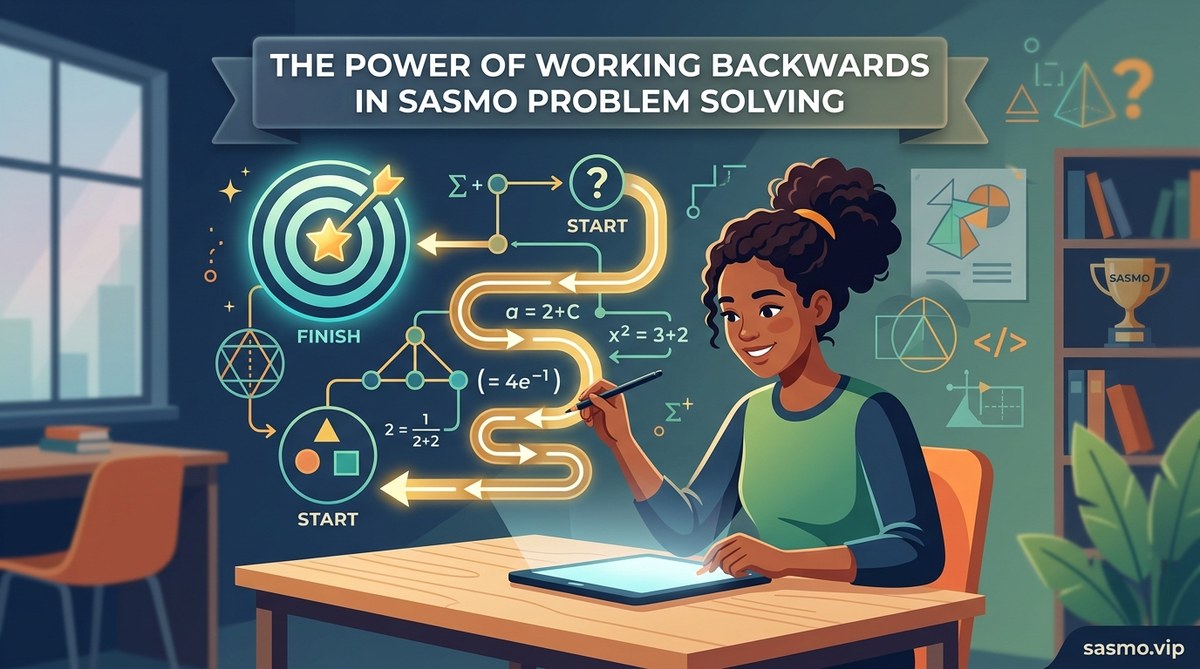
The Power of Working Backwards in SASMO Problem Solving
Some of the trickiest SASMO problems give you the ending and ask you to find the beginning. Your child reads the final result and needs to figure out what happened before. That’s where working backwards problem solving becomes a game changer.
This strategy flips the usual approach. Instead of starting at the beginning and calculating forward, students start at the end and reverse each operation. It’s particularly powerful for problems involving sequences of events, multiple steps, or situations where the final outcome is known but the starting point remains hidden.
Working backwards problem solving reverses the operations in a math problem, starting from the known final result and moving step by step toward the unknown beginning. This strategy excels when problems describe a sequence of actions with a clear endpoint. Students learn to undo addition with subtraction, multiplication with division, and reverse every transformation until they discover the original value or starting condition.
When working backwards makes sense
Not every problem needs this approach. Students waste time applying the wrong strategy to the wrong question. The working backwards method shines in specific situations.
Look for problems that describe a series of actions. Someone starts with an unknown amount, performs several operations, and ends with a known result. The problem might say “After giving away 5 marbles, then doubling what remained, Sarah had 18 marbles. How many did she start with?”
Another signal appears when the problem describes time moving forward but asks about an earlier point. Think of age problems where you know someone’s age now and need to figure out their age years ago.
Problems with multiple transformations also benefit from this strategy. Each step changes the value in a predictable way. Working backwards lets students peel away these layers one at a time.
The step-by-step process
Teaching this method requires a clear framework. Students need to understand not just what to do, but why each step matters.
-
Read the entire problem carefully and identify the final result. Write down this number or condition prominently.
-
List every operation or action that happened in the problem, in the exact order they occurred. Don’t skip any steps.
-
Reverse the order of operations. The last action becomes the first step in your solution.
-
Apply the inverse operation for each step. Addition becomes subtraction. Multiplication turns into division. Doubling means you halve the result.
-
Work through each reversed step methodically until you reach the starting value.
-
Check your answer by working forward through the original problem. Your calculated starting value should produce the given final result.
This systematic approach prevents the most common mistake: randomly trying operations until something seems to work. Math competitions reward logical thinking, not lucky guessing.
A concrete example from SASMO
Let’s work through a typical SASMO problem that demands this strategy.
“Tom had some money. He spent $8 on lunch. Then his friend paid him back $15 that he owed. After that, Tom bought a book for $12. He now has $23. How much money did Tom start with?”
The final amount is $23. That’s our starting point for working backwards.
List the operations in order:
– Spent $8
– Received $15
– Spent $12
– Has $23
Now reverse the order and the operations:
– Start with $23
– Undo the $12 book purchase by adding $12: $23 + $12 = $35
– Undo receiving $15 by subtracting $15: $35 – $15 = $20
– Undo spending $8 by adding $8: $20 + $8 = $28
Tom started with $28.
Check by working forward: $28 – $8 + $15 – $12 = $23. Correct.
This problem appears simple, but under competition pressure, students often lose track of which operations to reverse. Practice builds confidence.
Common mistakes and how to avoid them
Students make predictable errors when learning this strategy. Recognizing these pitfalls helps teachers guide learners more effectively.
| Mistake | Why it happens | How to fix it |
|---|---|---|
| Reversing operations incorrectly | Confusion about inverse operations | Create a reference chart showing operation pairs |
| Skipping steps | Trying to work too fast | Require written work for every single step |
| Forgetting to check the answer | Assuming the first answer is correct | Make verification a mandatory final step |
| Applying the strategy to inappropriate problems | Misunderstanding when to use this method | Practice identifying problem types first |
| Working with the wrong final value | Misreading the problem | Highlight or underline the final result before starting |
The most frequent error involves subtraction and addition. When a problem says “gave away 7,” students sometimes subtract 7 when working backwards instead of adding it back. Emphasize that giving away means subtraction going forward, so you add when going backward.
Building fluency through practice levels
Students shouldn’t jump into competition-level problems immediately. Scaffolding helps them master the technique progressively.
Start with single-operation problems. “After adding 15, I have 42. What number did I start with?” These build confidence and reinforce the concept of inverse operations.
Move to two-step problems next. “I doubled a number, then added 7, and got 25. What was my original number?” Students practice reversing two operations in sequence.
Three-step problems introduce complexity without overwhelming learners. “Maria had some stickers. She gave 8 to her brother, received 12 from her friend, then gave away half of what she had. She now has 15 stickers. How many did she start with?”
Competition problems often include four or more steps, sometimes with fractions or percentages. Build up to these gradually.
The key to mastering working backwards isn’t solving harder problems faster. It’s developing the patience to work through each step methodically, even when you think you see a shortcut. Shortcuts lead to errors under pressure.
Connecting to other SASMO strategies
Working backwards doesn’t exist in isolation. Strong problem solvers combine multiple strategies depending on the question.
Some problems require both what makes a problem solvable and working backwards. Students first need to determine whether they have enough information, then apply the reversal method.
Ratio problems sometimes benefit from this approach, especially when the final ratio is known but the original quantities are not. Understanding how to build strong algebraic thinking helps students recognize when working backwards overlaps with setting up and solving equations.
Time management during competitions matters too. Working backwards can be faster than algebraic methods for certain problems, but slower for others. Students who practice managing time effectively during competition day learn to choose their strategies wisely.
Teaching tips for parents and tutors
You don’t need to be a math expert to help your child master this strategy. Focus on the thinking process rather than getting the right answer immediately.
Use everyday situations to practice. “We have 12 cookies left after your sister ate 4 and I ate 3. How many did we bake?” These real-world scenarios make the strategy tangible.
Draw diagrams or use physical objects when introducing the concept. Manipulatives help visual learners understand the reversal process.
Encourage students to verbalize their thinking. “I’m undoing the last step, which was subtracting 5, so I need to add 5 back.” This self-talk reinforces the logic.
Create a “working backwards toolkit” with your student. List common operations and their inverses. Include examples of problem phrases that signal this strategy works well.
Celebrate the process, not just correct answers. A student who uses the method correctly but makes an arithmetic error is closer to mastery than one who guesses the right answer.
Practice problems to try
Here are several problems that respond well to working backwards. Start with easier ones and progress based on your student’s comfort level.
Beginner: “After subtracting 17 from a number, the result is 38. What was the original number?”
Intermediate: “A number is multiplied by 3, then 12 is added. The result is 45. Find the original number.”
Advanced: “Peter had some stamps. He gave one-third to his cousin, then bought 15 more. After that, he gave 8 to his neighbor. He now has 31 stamps. How many did he start with?”
Competition Level: “A container holds some water. First, 40 mL evaporates. Then someone adds water until the amount doubles. Next, 75 mL is poured out. Finally, someone adds 30 mL. The container now holds 145 mL. How much water was in the container originally?”
Work through these systematically. Write every step. Check each answer by working forward.
Recognizing when not to use this strategy
Knowing when to avoid working backwards is as important as knowing when to use it. Some problems look like good candidates but actually respond better to other methods.
Problems asking for patterns or sequences usually need different approaches. If the question asks “What is the 50th term in this sequence?” working backwards won’t help.
Geometry problems rarely benefit from this strategy unless they involve a sequence of transformations. Most geometry theorems that appear in SASMO papers require spatial reasoning instead.
Probability and combinatorics problems need counting principles. Working backwards doesn’t apply to questions about how many ways something can happen.
Word problems with simultaneous conditions often require systems of equations rather than reversal methods. If two unknowns interact with each other, algebraic thinking usually wins.
Train students to spend 15 to 20 seconds analyzing each problem before choosing a strategy. This brief planning phase saves time overall and reduces frustration.
Troubleshooting common struggles
Some students grasp this strategy immediately. Others need more support. Here’s how to address typical difficulties.
Struggle: Student can’t identify the final value in the problem.
Solution: Use a highlighter to mark the sentence containing the end result. Practice reading problems specifically to find “now has,” “ended with,” or “final amount.”
Struggle: Student reverses the sequence but not the operations.
Solution: Create two columns. Label one “Forward” and one “Backward.” Write operations in the forward column, then explicitly write the inverse in the backward column before calculating.
Struggle: Student makes arithmetic errors while working backwards.
Solution: Slow down. Use mental math shortcuts for simple calculations, but write out more complex steps.
Struggle: Student forgets to check their answer.
Solution: Make checking non-negotiable. Don’t look at the next problem until verification is complete.
Struggle: Student tries to work backwards on inappropriate problems.
Solution: Practice problem classification first. Sort 10 problems into “working backwards” and “other strategy” categories before solving any.
Variations and advanced applications
Once students master basic working backwards problems, introduce variations that appear in higher-level competitions.
Some problems involve percentages or fractions. “After spending 30% of her money, then earning $24, Jane has $74. How much did she start with?” These require careful attention to what the percentage applies to at each step.
Others combine working backwards with logical reasoning. “Three friends share some candies. The first takes half plus 2 more. The second takes half of what remains plus 2 more. The third gets the remaining 6 candies. How many candies were there originally?” This problem requires working backwards through a more complex sequence.
Multi-variable problems sometimes yield to this strategy when approached creatively. Students might work backwards to find one variable, then use that to find others.
Age problems frequently combine working backwards with algebraic thinking. “In 5 years, Sarah will be three times as old as she was 7 years ago. How old is Sarah now?” Working backwards from the future age helps visualize the solution.
Building confidence for competition day
Mastery comes from consistent practice, not cramming. Set up a practice schedule that includes working backwards problems twice weekly.
Mix problem types so students don’t fall into patterns. If they solve five working backwards problems in a row, they stop thinking about strategy selection.
Time some practice sessions to simulate competition pressure. Can your student solve three working backwards problems in 10 minutes? This builds both speed and accuracy.
Review mistakes thoroughly. Don’t just show the correct answer. Ask your student to identify exactly where their process broke down.
Keep a problem journal. When your student solves a challenging problem successfully, write it down with notes about what made it tricky. Review this journal before competitions.
Making working backwards second nature
The goal isn’t just solving problems correctly. It’s developing mathematical intuition about when and how to apply this powerful strategy.
Students who truly understand working backwards recognize it as more than a trick. It’s a way of thinking about relationships between operations. It builds flexibility in mathematical reasoning.
This flexibility transfers beyond competition math. Working backwards helps with algebraic thinking, equation solving, and even real-world problem solving. When you know the desired outcome and need to determine the steps to get there, you’re working backwards.
Practice until the strategy feels natural. Your student should read a problem and immediately think “This is a working backwards problem” without consciously analyzing why. That automaticity frees up mental energy for the actual solving.
Combine regular practice with reflection. After each practice session, ask “Which problems were easiest? Which were hardest? Why?” This metacognitive work accelerates improvement.
Turning reversal into mastery
Working backwards problem solving transforms how students approach math competitions. What once seemed impossible becomes manageable. Problems that confused them now have clear solution paths.
The beauty of this strategy lies in its logical simplicity. Every operation has an inverse. Every step can be undone. Students just need to work carefully and systematically.
Start teaching this method today. Pick one simple problem and work through it together. Write every step. Check the answer. Then try another. Your student’s confidence will grow with each successful problem.
Remember that competition success comes from mastering multiple strategies. Working backwards is one tool in a larger toolkit. Students who combine this with other problem-solving approaches become truly formidable competitors. The time you invest in teaching this method pays dividends throughout your student’s mathematical journey.