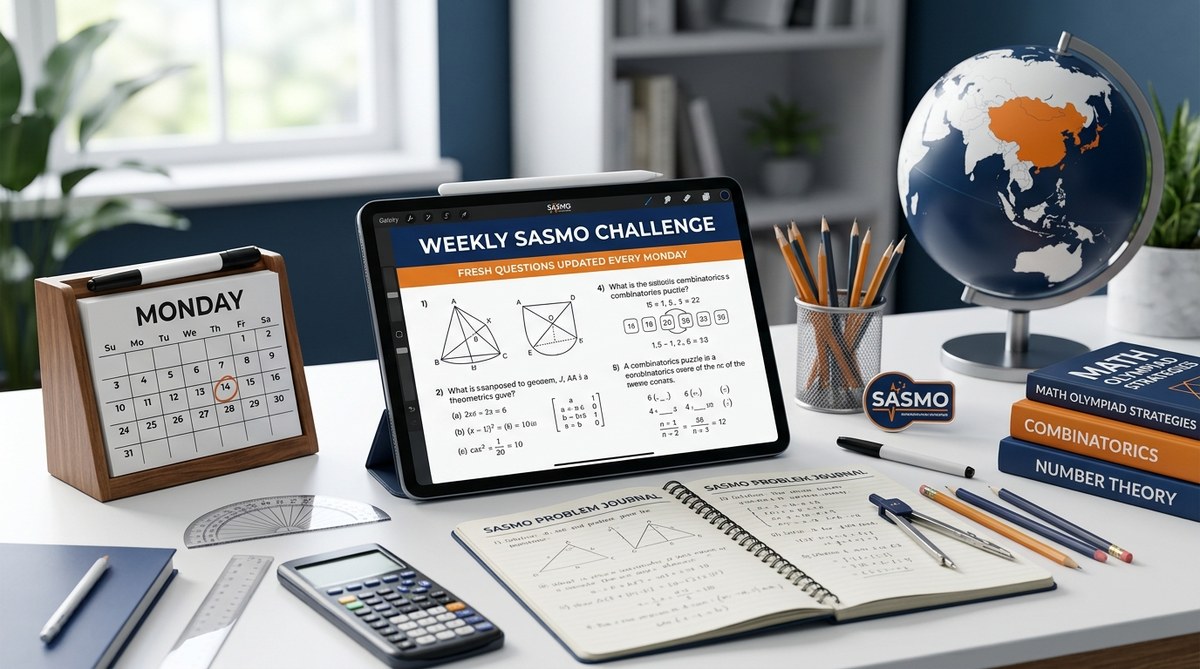
Weekly SASMO Problem Challenge: Fresh Questions Updated Every Monday
The Singapore and Asian Schools Math Olympiad (SASMO) challenges students across 12 grade levels with problems that test logic, creativity, and mathematical thinking far beyond classroom exercises. Parents and teachers searching for SASMO practice problems often find scattered PDFs, incomplete question banks, or materials that don’t match the competition’s evolving format. The right practice materials make the difference between a student who freezes during the exam and one who recognizes patterns, applies strategies, and works through problems with confidence.
Effective SASMO preparation requires grade-appropriate practice problems that mirror competition formats, build [pattern recognition](https://en.wikipedia.org/wiki/Pattern_recognition), and develop strategic thinking. Regular weekly practice with varied question types, combined with timed drills and solution analysis, helps students recognize problem structures and apply techniques confidently. Access to fresh problems, detailed solutions, and topic-specific resources creates a complete training system for competitive math success.
Understanding what makes SASMO problems different
SASMO questions differ from standard textbook exercises in structure and intent. Classroom problems typically test one concept at a time with clear instructions. Competition problems blend multiple concepts, hide critical information in diagrams or word problems, and reward creative approaches over memorized formulas.
A typical Grade 5 textbook might ask students to find the area of a rectangle given length and width. A SASMO problem at the same level might show overlapping shapes, require students to work backward from a total area, or present information through a pattern that must first be decoded.
The competition format includes three sections with increasing difficulty. Section A covers foundational concepts with straightforward calculations. Section B introduces multi-step reasoning and pattern recognition. Section C presents challenge problems that require insight, experimentation, and sometimes unconventional thinking.
Students who practice only textbook problems often struggle with the ambiguity and creativity SASMO demands. The solution requires exposure to competition-style problems regularly, building familiarity with how questions are constructed and what strategies work under time pressure.
Finding grade-appropriate practice materials
Each grade level from Primary 1 through Secondary 6 faces distinct mathematical concepts and difficulty levels. Practice materials must match both the student’s current grade and their preparation timeline.
Primary level students (Grades 1-6) encounter problems focused on:
- Number patterns and sequences
- Visual-spatial reasoning with shapes
- Logic puzzles requiring systematic thinking
- Word problems with multiple steps
- Fraction and ratio relationships
- Basic geometry and measurement
Secondary level students (Grades 7-12) face more advanced topics:
- Algebraic manipulation and equation solving
- Coordinate geometry and transformations
- Combinatorics and probability
- Number theory including divisibility and prime factorization
- Advanced geometry with proofs
- Functional thinking and optimization
The weekly SASMO problem challenge provides fresh questions updated every Monday, ensuring students encounter new problem types rather than memorizing solutions to repeated questions.
Building a systematic practice routine
Random problem solving without structure wastes time and builds frustration. A systematic approach develops skills progressively and identifies weak areas before competition day.
Follow this weekly practice schedule:
- Monday: Attempt three new problems from your grade level without time limits, focusing on understanding problem structure and finding multiple solution paths.
- Wednesday: Review Monday’s solutions, identify which concepts or techniques you missed, and practice five similar problems targeting those specific skills.
- Friday: Complete a timed 10-problem set mixing all difficulty levels, simulating competition pressure and building speed.
- Sunday: Analyze Friday’s performance, noting which problem types took longest and which strategies failed, then study solution techniques for those specific patterns.
This rhythm creates regular exposure without burnout. Students build momentum through the week and enter each Monday ready for new challenges.
Track progress using a simple practice log:
| Date | Problems Attempted | Correct | Time Taken | Topics Needing Review |
|---|---|---|---|---|
| Week 1 | 15 | 11 | 45 min | Ratio problems, pattern recognition |
| Week 2 | 15 | 13 | 38 min | Geometry angle relationships |
| Week 3 | 15 | 14 | 35 min | Multi-step word problems |
This data reveals improvement trends and persistent weak spots that need targeted attention.
Mastering core problem-solving strategies
Successful SASMO competitors rely on repeatable strategies rather than hoping inspiration strikes during the exam. These techniques work across problem types and grade levels.
Working backward solves problems that present an end result and ask for initial conditions. If a problem states “After giving away half her marbles and then 5 more, Sarah has 12 left,” start with 12, reverse each operation (add 5 to get 17, then double to get 34), and verify the answer.
Drawing diagrams transforms abstract word problems into visual representations. Even simple sketches of number relationships, movement patterns, or geometric configurations reveal solutions that remain hidden in text alone.
Testing extreme cases checks whether a solution makes sense. If a problem asks for the number of ways to arrange objects, test with the smallest possible number (often 1 or 2 items) to verify your formula produces logical results.
Pattern recognition identifies repeating structures in sequences, shapes, or number relationships. SASMO frequently tests whether students notice that a complex-looking sequence follows a simple rule like “add the previous two numbers” or “multiply by 2 and subtract 1.”
Students who master mental math shortcuts gain precious seconds on calculation-heavy problems, allowing more time for challenging questions.
Avoiding common practice mistakes
Many students practice ineffectively, spending hours on problems without building competition-ready skills. These mistakes undermine preparation efforts.
Checking answers immediately prevents genuine problem-solving development. Students who look at solutions after 30 seconds of thinking never build the persistence needed for Section C problems. Set a 10-minute minimum struggle time before reviewing hints or solutions.
Practicing only comfortable topics creates false confidence. A student strong in algebra but weak in geometry who practices only algebra will score poorly when geometry problems appear. Dedicate 40% of practice time to weak areas, 40% to mixed problems, and only 20% to strengths.
Ignoring time management during practice leads to panic during competition. Even when practicing individual problems, note how long each takes. Problems requiring more than 3-4 minutes during practice will consume too much time during the actual exam and should be skipped initially.
Skipping solution analysis wastes the learning opportunity. After solving a problem (correctly or incorrectly), study the official solution. Often, alternative methods exist that are faster or more elegant than your approach.
The difference between students who improve rapidly and those who plateau is not practice volume but practice quality. Analyzing why a solution works, where your thinking diverged from the optimal path, and what pattern you should recognize next time transforms practice from repetition into skill building.
Connecting practice to competition topics
SASMO problems cluster around specific mathematical domains. Recognizing these categories helps students identify which technique to apply.
Number theory problems involving divisibility, remainders, and prime numbers appear frequently. Understanding why number theory is the secret weapon every SASMO competitor needs provides foundation for these questions.
Geometry questions test spatial reasoning, angle relationships, and area calculations. The 7 geometry theorems that appear in nearly every SASMO paper covers essential concepts that solve numerous problems.
Algebraic thinking extends beyond equation solving to include pattern generalization and functional relationships. Students benefit from building strong algebraic thinking for math olympiads even at primary levels where formal algebra isn’t taught.
Counting problems require systematic enumeration without repetition or omission. The principles in combinatorics made simple help students organize their counting strategies.
Ratio and proportion problems appear across all grade levels with increasing complexity. The complete guide to ratio and proportion problems addresses common misconceptions and solution techniques.
Using timed drills effectively
Competition day brings time pressure that changes how students think. Practice without time limits builds problem-solving skills but doesn’t prepare students for the psychological challenge of the clock.
Start timed practice 8-10 weeks before competition day. Begin with generous time limits (twice the competition allowance) and gradually reduce to match actual conditions.
During timed drills:
- Mark problems that seem immediately solvable and complete those first
- Skip problems that don’t yield to 60 seconds of thought, returning later if time permits
- Budget time by section (Section A: 30%, Section B: 40%, Section C: 30%)
- Leave 5 minutes for reviewing answers and catching calculation errors
Students often discover that problems appearing difficult at first glance become clearer after completing easier questions. The brain continues processing challenging problems subconsciously while working on others.
Managing time effectively during SASMO competition day requires practice under realistic conditions, not just problem-solving ability.
Analyzing mistakes for maximum learning
Every error contains information about gaps in understanding or technique. Students who treat mistakes as learning opportunities improve faster than those who simply move to the next problem.
When a solution is incorrect, determine the error category:
- Conceptual misunderstanding: Didn’t know or misapplied a mathematical principle
- Calculation mistake: Understood the approach but made arithmetic errors
- Misread problem: Solved a different question than what was asked
- Incomplete solution: Found a partial answer but missed additional cases
- Strategic error: Chose an inefficient method that consumed too much time
Each category requires different remediation. Conceptual errors need topic review. Calculation mistakes need slower, more careful work. Misreading requires highlighting key words before solving. Incomplete solutions need systematic case-checking habits. Strategic errors benefit from studying alternative solution methods.
Keep a mistake journal noting:
- The problem that caused difficulty
- Which category of error occurred
- What concept or technique would have prevented the error
- One similar problem to practice the correct approach
This journal becomes a personalized study guide highlighting exactly what each student needs to review.
Leveraging solution techniques from challenge problems
Section C problems separate top performers from the rest. These questions require insight beyond standard techniques, but patterns exist in how they’re constructed.
Invariant principles identify quantities that remain constant despite changes in the problem. If a problem describes repeated operations, look for what stays the same (total count, sum, product, parity) rather than what changes.
Symmetry arguments simplify counting and geometry problems. When a problem has symmetrical structure, solve for one case and multiply rather than enumerating all possibilities.
Extremal thinking considers the maximum or minimum possible values. Problems asking “what is the largest” or “what is the smallest” often yield to testing boundary conditions.
Constructive proofs build examples demonstrating that a solution exists. When asked if something is possible, try creating a specific instance rather than reasoning abstractly.
The 10 most challenging SASMO geometry problems demonstrates how these advanced techniques apply to specific question types.
Creating a problem-solving toolkit
Successful competitors develop a mental toolkit of techniques they can deploy when standard approaches fail. This toolkit grows through exposure to diverse problem types.
Your toolkit should include:
- Guess and check systematically: Not random guessing, but organized testing of possibilities
- Simplify the problem: Reduce numbers, remove constraints, or solve a simpler version first
- Look for patterns: Test small cases and extrapolate to larger ones
- Change perspective: Reframe the problem using different units, viewpoints, or representations
- Break into cases: Divide complex problems into exhaustive, non-overlapping scenarios
Understanding what makes a problem solvable helps students recognize when to apply each tool.
Practice applying each technique deliberately. When solving a problem, after finding the answer, ask: “Could I have used a different technique? Which approach was most efficient?”
Balancing breadth and depth in practice
Students face a tension between practicing many problems quickly versus working through fewer problems thoroughly. The optimal balance depends on preparation stage and current skill level.
Early preparation (3-4 months before competition) emphasizes breadth. Expose yourself to many problem types, identify weak areas, and build familiarity with competition format. Aim for 15-20 problems weekly across all topics.
Middle preparation (6-8 weeks before) shifts toward depth. Select problems targeting identified weaknesses and work through complete solutions, including alternative methods. Reduce volume to 10-12 problems weekly but spend twice as long on each.
Final preparation (2-3 weeks before) returns to breadth with timed mixed sets simulating competition conditions. Focus on execution, time management, and maintaining accuracy under pressure.
This periodization prevents burnout while building comprehensive skills. Students who practice 50 problems weekly for two weeks then quit accomplish less than those maintaining 12-15 problems weekly for three months.
Integrating peer practice and discussion
Solving problems alone builds individual skills but misses the learning that comes from explaining thinking and hearing alternative approaches. Group practice sessions enhance understanding when structured properly.
Organize weekly problem-solving sessions with 2-4 students at similar levels. Each session should:
- Begin with 20 minutes of individual problem-solving on the same 3-4 problems
- Follow with round-robin presentations where each student explains their approach to one problem
- Discuss alternative methods and vote on which technique was most elegant or efficient
- End with attempting one new problem collaboratively, verbalizing thinking aloud
The act of explaining a solution reveals gaps in understanding. Students who can solve a problem but struggle to articulate their method haven’t fully mastered the technique.
Peer practice also builds the communication skills valuable beyond competition math. Articulating mathematical reasoning clearly is essential for advanced study and professional work.
Accessing comprehensive problem banks
Quality practice requires access to problems that match competition standards. Free resources exist but often lack solutions, organization by difficulty, or grade-appropriate selection.
The weekly SASMO problem challenge provides curated problems updated regularly, ensuring fresh material throughout the preparation period.
Supplement weekly challenges with:
- Past SASMO papers (official releases from previous years)
- Similar olympiad questions from NMOS, RIPM, or AMC competitions
- Topic-specific problem sets focusing on identified weak areas
- Mock tests simulating full competition format and timing
Organize practice materials by topic and difficulty rather than working through problems sequentially. This allows targeted practice on specific skills rather than random exposure.
Maintain a collection of favorite problems that taught important techniques. Reviewing these periodically reinforces key concepts and builds confidence before competition day.
Preparing for competition day logistics
Problem-solving skills matter little if students arrive unprepared for the competition environment. Practical preparation prevents day-of surprises.
One week before competition:
- Complete a full mock test under exact time conditions (no breaks, no calculator, same time of day as the actual competition)
- Prepare materials (pencils, eraser, ruler, water bottle, watch)
- Review competition rules about allowed materials and answer sheet format
- Visit the competition venue if possible to reduce anxiety about unfamiliar surroundings
The night before:
- Review your mistake journal noting common error patterns to avoid
- Solve 2-3 warm-up problems to activate mathematical thinking
- Prepare everything needed for morning (clothes, materials, directions, backup transportation plan)
- Sleep 8-9 hours rather than cramming additional practice
Competition morning:
- Eat a substantial breakfast with protein and complex carbohydrates
- Arrive 30 minutes early to settle in and use facilities
- Do 5 minutes of mental warm-up (visualizing solving problems calmly, reviewing key formulas)
- Avoid discussing difficult problems with other students, which increases anxiety
These logistics seem minor but significantly impact performance. A student who arrives rushed, hungry, or anxious will underperform their practice results.
Building long-term mathematical thinking
SASMO preparation develops skills valuable far beyond one competition. The problem-solving strategies, persistence, and creative thinking transfer to academic work, career challenges, and everyday decision-making.
Students who practice regularly over months rather than cramming before competition develop:
- Resilience: Comfort with confusion and willingness to try multiple approaches
- Pattern recognition: Ability to identify underlying structure in complex situations
- Systematic thinking: Breaking large problems into manageable components
- Metacognition: Awareness of their own thinking process and when to change strategies
These skills compound over years. A student who competes in SASMO from Grade 3 through Grade 10 builds mathematical maturity that accelerates learning in high school and university mathematics.
View SASMO preparation as training in thinking, not just competition preparation. The problems are vehicles for developing intellectual capabilities that serve students throughout their education and careers.
Turning practice into performance
Thousands of practice problems mean nothing if students can’t perform when it counts. The gap between practice and performance closes through deliberate preparation that simulates competition conditions.
Mental rehearsal builds confidence. Spend 10 minutes daily visualizing yourself calmly reading problems, recognizing patterns, and writing solutions. Imagine handling difficult problems without panic, skipping appropriately, and managing time well.
Physical practice under realistic conditions trains your body and mind for competition day. Complete at least three full-length mock tests in the month before competition, matching exact timing, environment, and rules.
Develop a personal competition ritual. This might be three deep breaths before starting, a specific order for reading through all problems first, or a gesture that signals confidence. Consistent rituals trigger the calm, focused state practiced during preparation.
Remember that competition performance rarely exceeds practice performance. Students who consistently score 18/25 during practice should expect similar results on competition day. Setting realistic expectations based on practice results reduces pressure and allows students to perform at their actual capability level.
The goal is not perfection but demonstrating your current best thinking under time constraints. Every student who prepares systematically, learns from mistakes, and approaches competition day with confidence has already succeeded regardless of final scores.
Making every practice session count
SASMO practice problems are most valuable when approached systematically with clear goals, regular scheduling, and thorough analysis. Students who treat practice as deliberate skill-building rather than random problem-solving see dramatic improvement over weeks and months.
Start where you are, practice consistently, and track your progress. The combination of fresh problems, targeted weak-area work, timed drills, and solution analysis creates comprehensive preparation. Competition day becomes an opportunity to demonstrate skills you’ve built confidently rather than a test you hope to pass through luck.
Your mathematical thinking grows with every problem attempted, every mistake analyzed, and every new technique mastered. That growth continues long after competition day ends, making SASMO preparation an investment in capabilities you’ll use for years to come.