6 Visualization Tricks That Simplify Complex SASMO Geometry Problems
Geometry problems in SASMO can feel like a brick wall. You read the question. You stare at the diagram. Nothing clicks. The shapes twist, the numbers blur, and the clock keeps ticking. Many students think the answer requires a genius level flash of insight. That is not true. Most SASMO geometry problems become simple once you know how to see them differently. Visualization is the secret ingredient. It turns abstract relationships into pictures your brain can process instantly. Here are six visualization tricks that will change how you approach SASMO geometry forever.
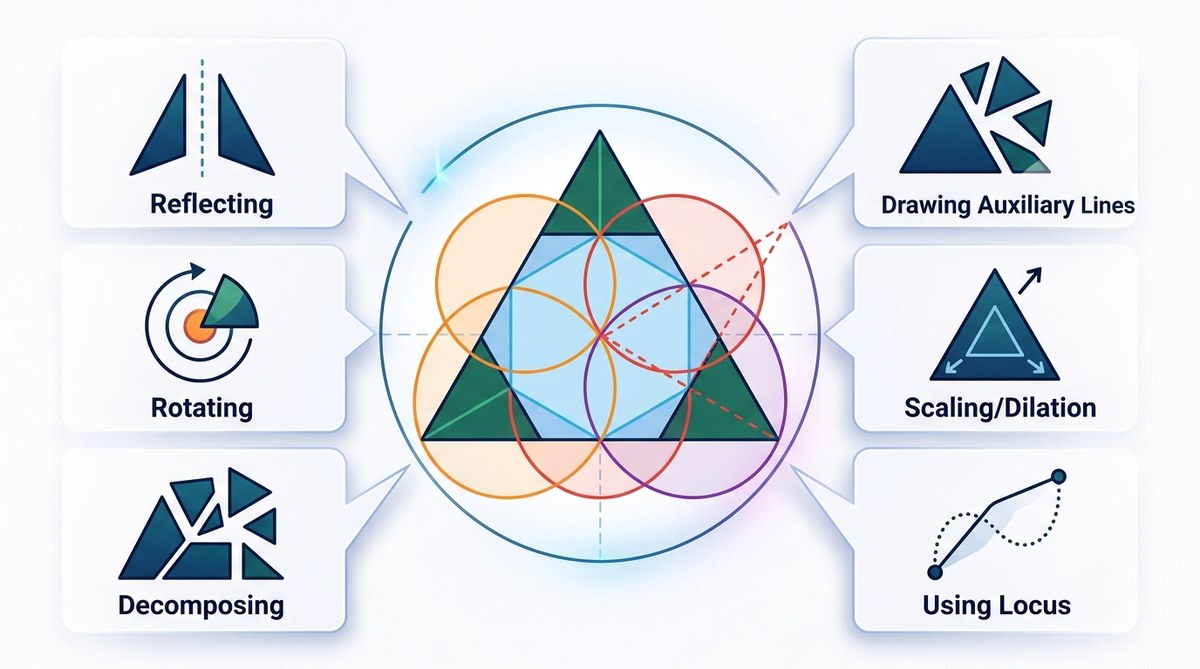
SASMO geometry rewards students who can redraw and simplify. The six tricks covered here are color coding, symmetry spotting, decomposition into familiar shapes, coordinate placement, angle chasing with parallel lines, and scaling. Each trick reduces visual clutter and reveals hidden relationships. Master these, and you will solve problems faster with fewer errors. Practice them on past papers to build automatic reflexes.
Color Code Your Way to Clarity
Your brain processes color faster than text or shape outlines. When a SASMO geometry problem shows overlapping triangles, circles, and squares, use colored pencils or highlighters to separate the information.
Here is the method:
- Pick one color for each distinct shape or region mentioned in the problem.
- Lightly shade the areas that share a relationship (like congruent triangles or supplementary angles).
- Use a third color to mark unknown values you need to find.
- Keep a clean copy of the original diagram nearby for reference.
A student once struggled with a SASMO problem about three overlapping squares. The diagram looked like a mess of lines. After shading each square a different color, the overlapping region that formed a right triangle jumped out. The solution took thirty seconds.
Color coding works because it offloads mental sorting. Your eyes do the work instead of your memory.
Spot Hidden Symmetry Before You Calculate
Symmetry is a cheat code. Many SASMO geometry problems hide symmetrical relationships inside shapes that look irregular at first glance.
Watch for these symmetry clues:
- A line that divides a shape into two mirror halves
- Angles that repeat in a pattern
- Lengths that are equal but not labeled
- Rotational symmetry where a shape looks the same after a turn
When you find symmetry, you often cut the problem in half. For example, if a diagram shows a figure with reflective symmetry, you only need to calculate one side. The other side is identical.
Expert advice: “If a SASMO problem feels too hard, ask yourself one question: Is there a line I can draw that makes this shape look the same on both sides? If yes, you have found the shortcut.” This tip comes from a veteran SASMO coach who has trained multiple gold medalists.
Symmetry also helps you check your work. If your answer breaks the symmetry of the original figure, you made a mistake.
Decompose Complex Shapes Into Familiar Ones
SASMO loves to combine basic shapes into monsters. A weird polygon might be a rectangle with a triangle cut out. A star might be two overlapping equilateral triangles. Your job is to see the simple shapes hiding inside.
Follow this numbered process when you face a complex shape:
- Trace the outline of the entire figure on scratch paper.
- Look for straight lines that divide the shape into smaller pieces.
- Identify each piece as a triangle, square, rectangle, circle, or semicircle.
- Write down the area or perimeter formula for each piece.
- Add or subtract the pieces according to the diagram.
A common SASMO trap shows a large square with a smaller square removed from one corner. Students try to calculate the remaining area using a complicated formula. The trick is to see the shape as a large square minus a small square. That is subtraction, not addition.
For deeper practice on breaking down tough figures, check out our guide on mastering geometric constructions to excel in SASMO geometry challenges.
Place the Figure on a Coordinate Grid
Coordinate geometry turns shapes into numbers. When a SASMO problem gives you lengths and angles but no grid, you can create one yourself.
Here is how to use this trick:
- Set one corner of the shape at point (0, 0) on an imaginary coordinate plane.
- Place another known point on the x-axis to simplify calculations.
- Use the given lengths to find the coordinates of every vertex.
- Apply the distance formula or midpoint formula to find unknown values.
This trick works especially well for problems involving rectangles, right triangles, and parallelograms. It transforms a visual puzzle into an algebraic one. Many students find algebra easier to manage than spatial reasoning under time pressure.
Imagine a problem that asks for the distance between the midpoints of two diagonals in a trapezoid. Drawing a coordinate grid makes the midpoints obvious. No guesswork required.
Chase Angles Using Parallel Lines
Parallel lines are gold mines in SASMO geometry. When you see parallel lines, you unlock a set of angle relationships that simplify everything.
The key relationships to remember are:
- Corresponding angles are equal
- Alternate interior angles are equal
- Same side interior angles add up to 180 degrees
When a diagram shows parallel lines cut by a transversal, label every angle you can find. Start with the given angle and fill in the rest like a puzzle. This technique is called angle chasing.
A typical SASMO problem might show two parallel lines with a zigzag path connecting them. The student needs to find one missing angle. By chasing the angles step by step, the answer reveals itself without any complicated formulas.
For a full list of angle chasing techniques, read our article on 5 angle-chasing techniques every SASMO geometry problem requires.
Scale the Figure to Avoid Fractions
SASMO geometry problems sometimes use fractions or decimals that make mental math messy. You can avoid this by scaling the entire figure.
The rule is simple: multiply every length in the problem by a number that turns all values into whole numbers. Solve the problem with the scaled numbers. Then divide your answer by the same factor at the end.
For example, if a problem gives side lengths of 1.5 cm and 2.5 cm, multiply everything by 2. Now you have 3 cm and 5 cm. Solve the problem. If your answer is 15, divide by 2 (or by the square of 2 if dealing with area) to get the real answer.
This trick reduces calculation errors. It also makes proportional reasoning easier because you work with clean numbers.
| Technique | When to Use | Common Mistake |
|---|---|---|
| Color coding | Overlapping shapes | Shading too many areas at once |
| Symmetry spotting | Irregular looking figures | Assuming symmetry where none exists |
| Decomposition | Complex polygons | Forgetting to subtract overlapping regions |
| Coordinate placement | Right angles and known lengths | Placing the origin at a non right angle vertex |
| Angle chasing | Parallel lines and transversals | Confusing corresponding and alternate angles |
| Scaling | Fractional or decimal lengths | Forgetting to reverse the scale for area |
Train Your Eyes With Daily Practice
These visualization tricks are not magic. They are skills. Like any skill, they improve with practice. Set aside ten minutes each day to look at a SASMO geometry problem and apply one trick. Do not try to solve it immediately. Just practice seeing the shapes differently.
Start with problems from past SASMO papers. Redraw the diagrams. Color them. Break them apart. Look for symmetry. Place them on a grid. Chase the angles. Scale the numbers. Each repetition builds a mental habit.
Your brain will learn to spot these patterns automatically during the real competition. That is when the magic happens. You will glance at a problem and know exactly which trick to use.
Your Geometry Toolkit Is Ready
You now have six visualization tricks that simplify complex SASMO geometry problems. Color coding clears visual noise. Symmetry halves your work. Decomposition turns monsters into building blocks. Coordinate placement makes shapes measurable. Angle chasing unlocks parallel line secrets. Scaling removes fraction frustration.
The next time you face a tough SASMO geometry problem, pause before you panic. Pick one trick from this list. Apply it. Watch the problem transform from impossible to manageable.
For more practice, browse our collection of 10 most challenging SASMO geometry problems and how to solve them. Each problem in that guide uses one or more of these visualization tricks. Work through them step by step. Your confidence will grow with every diagram you conquer.
You have the tools. Now go make them your own.