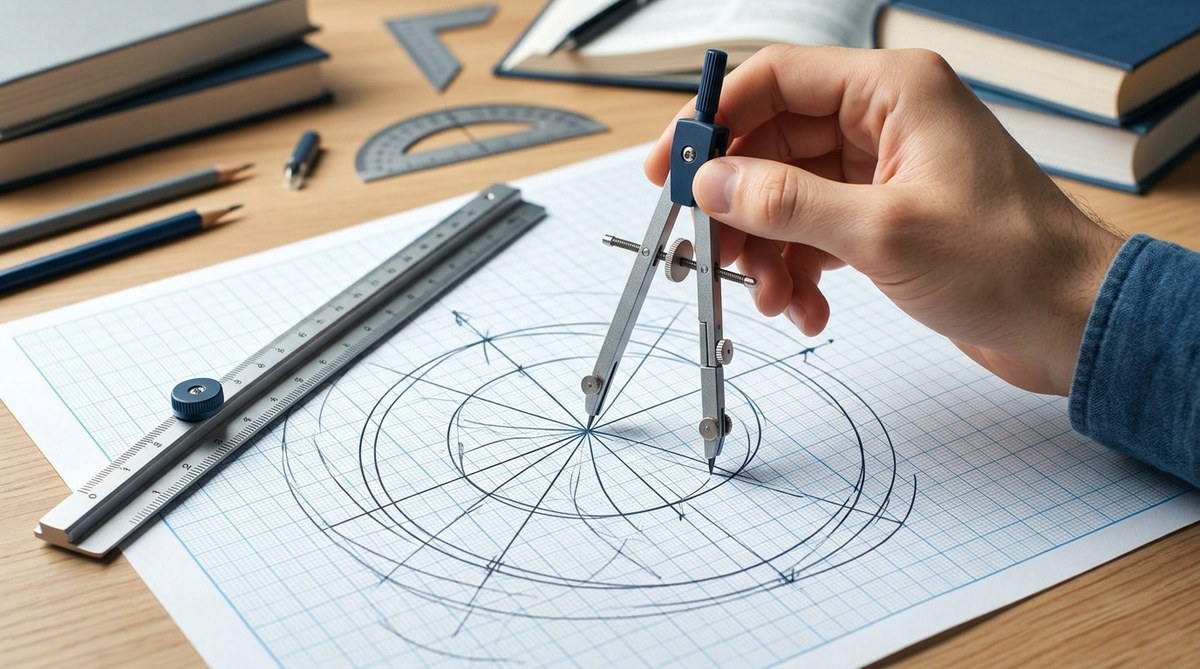
Mastering Geometric Constructions to Excel in SASMO Geometry Challenges
Preparing for SASMO geometry challenges requires more than just basic skills. It demands a deep understanding of geometric constructions, problem-solving strategies, and the ability to implement them under exam conditions. Mastering these techniques can significantly boost your confidence and accuracy. Whether you’re a student aiming for a top score or an enthusiast eager to sharpen your skills, this guide offers a comprehensive approach to mastering geometric constructions for SASMO.
Why Geometric Constructions Matter in SASMO
SASMO often features problems that test your ability to visualize and create geometric figures accurately. These questions evaluate your understanding of shape properties, angles, and spatial relationships. Many challenging problems can be simplified by constructing auxiliary lines, points, or circles that reveal hidden symmetries or congruencies.
Developing proficiency in geometric constructions allows you to tackle problems more strategically. Instead of relying solely on algebra or brute-force methods, you learn to manipulate figures directly, making complex problems more manageable. This skill set is essential for solving advanced questions efficiently and accurately.
Key Techniques for Effective Geometric Constructions
Mastering a few core techniques can provide a solid foundation for a wide range of problems. Here are some essential methods:
- Using a compass and straightedge to construct basic figures: Building equilateral triangles, bisecting angles, and copying segments are fundamental skills.
- Constructing perpendicular bisectors and angle bisectors: These help find midpoints and divide angles accurately, crucial for many constructions.
- Creating parallel lines and similar triangles: These techniques are vital in problems involving proportionality and similarity.
- Drawing circles with given centers and radii: Circles are often used to locate points of intersection or to create specific angles.
- Finding intersections of lines and circles: This skill allows you to determine key points necessary for completing complex figures.
Practical Process for Geometric Constructions
Follow these steps to sharpen your construction skills:
- Read the problem carefully: Identify what points, lines, or angles need to be constructed.
- Visualize the figure: Sketch a rough diagram to understand relationships.
- Plan your construction steps: Decide which basic techniques to use first.
- Execute with precision: Use your compass and straightedge carefully, avoiding sloppy lines.
- Verify your constructions: Check that created points satisfy the problem conditions before proceeding.
Tips for Improving Construction Accuracy
- Always use a sharp pencil for clean lines.
- Keep your compass at a consistent radius when copying lengths.
- Double-check intersection points and angles.
- Practice freehand sketching to develop better visualization.
- Use auxiliary constructions to simplify complex steps.
Common Mistakes and How to Avoid Them
| Mistake | How to Avoid |
|---|---|
| Using a compass with an inconsistent radius | Always set the compass carefully and test on scrap paper before use. |
| Drawing lines that are not precise | Keep your ruler steady and use light strokes initially. |
| Forgetting to verify intersections | Cross-check with the diagram to ensure points lie where expected. |
| Overcomplicating constructions | Use the simplest approach; if a step seems complex, look for a shortcut or auxiliary line. |
| Ignoring given data | Pay close attention to all problem details to avoid missing key clues. |
Expert Tip: “Practice constructing common figures repeatedly. Over time, your muscle memory and intuition will help you perform constructions faster and with greater accuracy.”
Practice Strategies for Mastery
- Daily drills: Dedicate 10 minutes each day to practice common constructions.
- Timed exercises: Simulate exam conditions by setting time limits.
- Use problem sets: Tackle geometry problems from past SASMO papers or online resources.
- Analyze your mistakes: Review errors carefully to understand where your technique can improve.
- Learn from others: Watch tutorials or join study groups focused on geometry constructions.
Sample Practice Problem
Construct an equilateral triangle given a segment AB. Then, find the centroid of the triangle and draw a circle passing through all three vertices.
This problem involves multiple skills: constructing an equilateral triangle, locating the centroid, and drawing a circumscribed circle. Break it down step-by-step:
- Construct an equilateral triangle using the compass and straightedge.
- Find the centroid by connecting medians.
- Draw the circle passing through the vertices by using the triangle’s circumcenter.
Practicing such multi-step problems helps build confidence and fluency.
Techniques Table to Clarify Methods and Mistakes
| Technique | When to Use | Common Mistakes | Tips to Improve |
|---|---|---|---|
| Constructing perpendicular bisectors | To find midpoints and create symmetric figures | Not marking the midpoint accurately | Use the intersection of two arcs from endpoints |
| Angle bisectors | To divide angles into equal parts | Overlooking the correct vertex | Verify the angle divisions with a protractor or estimation |
| Drawing parallel lines | When proportionality or similar figures are needed | Not maintaining the correct distance | Use a ruler and set your compass to mark equal distances |
| Creating circles with given radius | Locating points equidistant from a center | Radii mismatch | Double-check compass setting before drawing |
Final Tips for Geometric Constructions in SASMO
“Always practice constructing figures with precision. The more comfortable you are with the tools, the faster and more accurate your solutions will be.” Remember, careful construction can turn a complex problem into a straightforward solution.
Consistent practice is key. Regularly challenge yourself with different geometric problems. Focus on understanding the reasoning behind each step rather than just copying techniques. Over time, you’ll notice your constructions becoming more intuitive, saving precious time during exams.
Building Your Geometric Construction Toolbox
As you advance, build a collection of reliable techniques and shortcuts. Memorize key construction patterns like angle bisectors, perpendiculars, and midpoints. Recognize common figure configurations, such as cyclic quadrilaterals or inscribed angles, which often appear in SASMO problems.
Creating a mental or physical checklist of construction steps can help streamline your approach. This systematic method allows you to focus more on problem-solving rather than figuring out how to draw the figure.
Sharing Your Progress and Growing as a Mathematician
Joining online communities or participating in mock tests can accelerate your learning. Sharing your constructions and receiving feedback helps identify areas for improvement. Remember, mastery in geometric constructions is a journey of continuous practice and curiosity.
Achieve Your Best in SASMO Geometry
Mastering geometric constructions opens doors to solving challenging problems confidently. Use the techniques and tips shared here to sharpen your skills systematically. Keep practicing, stay patient, and approach each problem as an opportunity to learn something new. This disciplined approach will serve you well not only in SASMO but in future mathematical pursuits.
Keep Building Your Geometric Skills for SASMO Triumphs
Every construction you complete adds to your toolkit of problem-solving strategies. Over time, you’ll notice your ability to visualize and manipulate figures improves noticeably. Carry this confidence into your practice sessions and exams. With dedication and regular effort, you’ll find yourself solving geometry problems with greater clarity and speed. Keep practicing, and enjoy the journey of mastering the art of geometric constructions.