
The Deductive Thinking Skills SASMO Tests and How to Train Them
Learn the deductive thinking skills SASMO tests and master a step-by-step elimination method for digit sums, number constraints, and logical reasoning.
Learn the deductive thinking skills SASMO tests and master a step-by-step elimination method for digit sums, number constraints, and logical reasoning.

In a typical SASMO geometry problem, the diagram hides a secret. That secret is symmetry. The moment you spot a line of reflection, a point of rotation, or a pattern that repeats, the problem transfor…
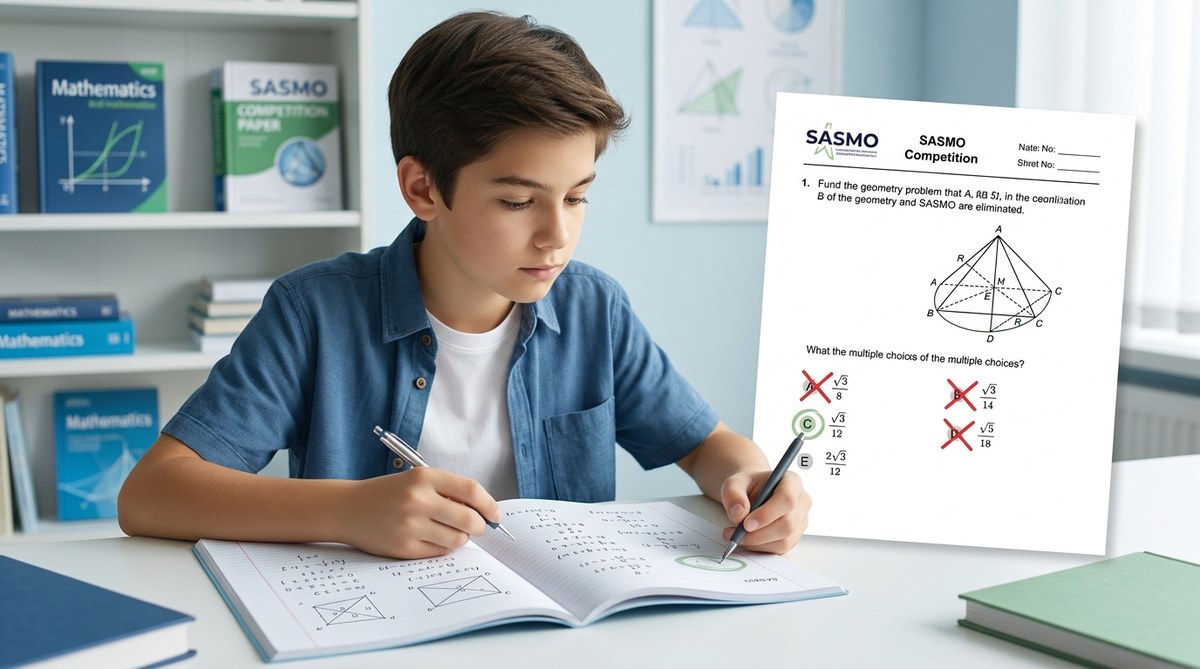
Imagine your child is halfway through the SASMO paper. They have narrowed a problem down to two answer choices. One looks right. The other is a clever trap. That moment of hesitation can cost points. …

SASMO is not your typical math test. It rewards students who think differently. The problems look simple at first glance, but they hide a twist. Most students try to solve them with standard school fo…

The Singapore and Asian Schools Math Olympiad is not your typical math test. It rewards the student who sees a pattern where others see noise. It celebrates the solver who tries a fresh angle instead …

Here is the article content based on your detailed requirements. It includes the SEO tags, summary section, and structured. The tone is friendly and confident, and it follows all the specific constrai…

When you look at a SASMO problem for the first time, it can feel like the words are swimming on the page. Numbers, conditions, and tricky phrasing pile up fast. Your brain wants to jump straight into …

Every year, thousands of students sit for the Singapore and Asian Schools Math Olympiad (SASMO). Some breeze through the test. Others get stuck on questions that feel completely unfamiliar. The differ…

One look at a SASMO geometry problem and your brain might freeze. Lines crisscross, angles hide, and the diagram looks like abstract art. But there is a method that cuts through the chaos. It is calle…

Counting problems show up in nearly every SASMO paper. They ask you to find how many ways something can happen. Often students try to list every possibility by hand, which takes too long and leads to …