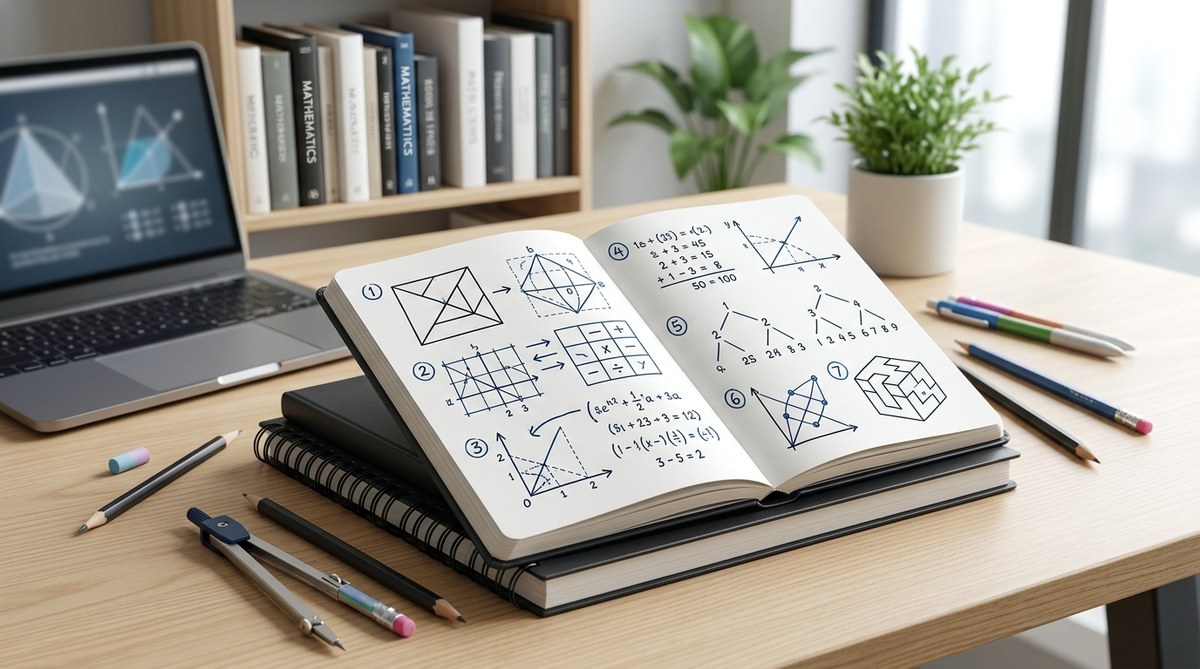
7 SASMO Problems That Test Your Creative Thinking – Can You Crack Them?
The Singapore and Asian Schools Math Olympiad (SASMO) is famous for one thing: problems that look simple but require a flash of insight. You might know all the formulas, but the exam still throws questions that make you stop and think. That is the whole point. SASMO problems creative thinking is not just a skill; it is the main event. These problems do not test how fast you can calculate. They test how well you can spot a hidden pattern, break an assumption, or find a shortcut no one told you about.
Creative thinking in SASMO is not about being naturally gifted. It is about learning to look at a problem from a new angle. This guide walks through seven real SASMO style problems that demand that kind of thinking. Each one comes with a breakdown of the logic, the common mistakes, and the technique you can reuse on similar questions.
What Makes a SASMO Problem a Creative Thinking Problem?
Standard math problems ask you to apply a known formula. Creative thinking problems ask you to find the formula that fits. They often hide the math behind a story, a diagram, or a weird set of conditions. The hardest part is not the calculation. It is figuring out what the problem is actually asking.
Here is a list of traits that show up again and again in creative SASMO problems:
- The problem gives you too much information, forcing you to filter out noise.
- The problem gives you too little information, forcing you to infer or estimate.
- The answer requires combining two or more math topics (like geometry and number theory).
- The obvious method is too slow, and the elegant method is hidden.
- The problem asks for a “minimum” or “maximum” value, which suggests you need to test boundaries.
If you see any of these signs, you know you are facing a creative thinking question. Do not panic. That is where the fun begins.
Problem 1: The Misleading Pattern
Question: What is the next number in this sequence? 2, 3, 5, 9, 17, ?
Most students see the differences: 1, 2, 4, 8. That looks like powers of 2. The next difference would be 16, so the next number is 17 + 16 = 33. That is correct. But the creative twist is that the pattern is also “double the previous number and subtract 1.” 2 x 2 minus 1 = 3. 3 x 2 minus 1 = 5. 5 x 2 minus 1 = 9. 9 x 2 minus 1 = 17. 17 x 2 minus 1 = 33. Both methods work, but the second one is more reliable for longer sequences.
Why this tests creative thinking: The problem rewards students who see two different patterns and can verify them against each other. It also punishes students who stop at the first difference pattern and assume it is the only one.
Problem 2: The Missing Digit Puzzle
Question: A two digit number has a tens digit that is 3 more than the units digit. The number itself is 6 times the sum of its digits. What is the number?
Let the units digit be U. The tens digit is U + 3. The number is 10(U + 3) + U = 11U + 30. The sum of the digits is (U + 3) + U = 2U + 3. The problem says the number is 6 times the sum: 11U + 30 = 6(2U + 3). Solve: 11U + 30 = 12U + 18. Subtract 11U: 30 = U + 18. U = 12. That cannot be right because a digit must be between 0 and 9.
Wait. This is the trap. The tens digit is 3 more than the units digit, but that does not mean the tens digit itself is valid if U = 12. Actually, U = 12 is impossible. There is no solution? That is the creative twist. The problem has no valid two digit number that satisfies both conditions. The correct answer is “no such number.”
Why this tests creative thinking: Most students assume every puzzle has a solution. This problem forces them to check their work and realize that sometimes the answer is that the problem is impossible. It teaches the value of verification.
Problem 3: The Grid of Squares
Question: How many squares of any size can you find on a 4×4 grid?
A 4×4 grid has 16 small squares. But you also have 2×2 squares, 3×3 squares, and one 4×4 square. Count them:
- 1×1 squares: 16
- 2×2 squares: 9
- 3×3 squares: 4
- 4×4 squares: 1
Total: 16 + 9 + 4 + 1 = 30 squares.
Why this tests creative thinking: Students often only count the small squares. The creative leap is to realize that squares can overlap and be different sizes. This is a classic combinatorial geometry problem that appears in SASMO. For a deeper look at how spatial thinking helps, check out our guide on why spatial visualization skills give you an edge in SASMO geometry.
Problem 4: The Fake Coin Riddle
Question: You have 9 identical coins. One is counterfeit and weighs less than the others. You have a balance scale. What is the minimum number of weighings needed to guarantee finding the fake coin?
The answer is 2 weighings. Divide the coins into three groups of three. Weigh group 1 against group 2. If they balance, the fake is in group 3. If they do not, the lighter side contains the fake. Then take the three coins from the suspect group. Weigh two of them. If they balance, the third is fake. If not, the lighter one is fake.
Why this tests creative thinking: The natural instinct is to weigh coins one by one. The creative solution uses grouping to eliminate possibilities in bulk. This is a classic example of how logical reasoning connects all SASMO math topics together.
Problem 5: The Age Puzzle
Question: Alice is 3 times as old as Bob. In 5 years, she will be twice as old as Bob. How old is Alice now?
Let Bob’s current age be B. Alice’s current age is 3B. In 5 years, Alice is 3B + 5 and Bob is B + 5. The equation is 3B + 5 = 2(B + 5). Solve: 3B + 5 = 2B + 10. Subtract 2B: B + 5 = 10. B = 5. So Alice is 3 x 5 = 15.
Why this tests creative thinking: The puzzle is simple algebra, but many students try to guess and check. The creative thinker sets up the equation and solves it in seconds. It is a reminder that algebra is a creative tool, not just a memorized procedure.
Problem 6: The Tangram Area
Question: A tangram set consists of 7 pieces that can form a square. If the whole square has an area of 64 square inches, what is the area of the smallest triangle?
The smallest triangle is half of the medium triangle, which is half of the large triangle. The large triangle covers one quarter of the square. So the large triangle area is 64 / 4 = 16. The medium triangle is half of that: 8. The smallest triangle is half of that: 4 square inches.
Why this tests creative thinking: The problem requires visualizing how the pieces fit together without a diagram. It tests spatial reasoning and the ability to work with fractions of area.
Problem 7: The Number of Handshakes
Question: At a party, every person shakes hands with every other person exactly once. If there are 10 people, how many handshakes occur?
Each person shakes hands with 9 others. That is 10 x 9 = 90, but that counts each handshake twice (once for each person). So divide by 2: 45 handshakes. The general formula is n(n 1) / 2.
Why this tests creative thinking: The trap is to say 90. The creative thinker realizes the double counting. This is a foundational concept in combinatorics. For more on this topic, see our guide on how to tackle SASMO counting problems using the multiplication principle.
Common Mistakes and How to Fix Them
Here is a table that summarizes the most frequent errors students make on creative thinking problems, along with the fix.
| Common Mistake | Why It Happens | How to Fix It |
|---|---|---|
| Assuming every problem has a solution | Overconfidence or rushing | Always check your answer against the original conditions. If it breaks a rule, reconsider. |
| Counting only the obvious items (like only 1×1 squares) | Lack of systematic thinking | Make a list of all possible sizes or categories before you start counting. |
| Forgetting to divide by 2 in handshake problems | Not accounting for double counting | Ask yourself: “Did I count each pair twice?” If yes, divide. |
| Using guess and check when algebra is faster | Fear of variables | Write down what you know in symbols. Even a simple equation saves time. |
| Ignoring the possibility of “no solution” | Expectation bias | Treat “no solution” as a valid answer. The problem setter might be testing for that. |
A Simple Process for Tackling Any Creative SASMO Problem
When you hit a wall, use this numbered process to break through.
- Restate the problem in your own words. Remove the story and find the pure math question.
- List what you know. Write down every number, condition, and constraint.
- List what you need to find. Make sure you understand the goal.
- Try a smaller version. If the problem uses 10 people, try 3. See if a pattern emerges.
- Check for hidden assumptions. Are you assuming the answer is a number? Could it be “impossible”?
- Test your answer. Plug it back into the original problem. Does it fit every condition?
- If stuck, move on. Come back later. Your brain will work on it in the background.
“The best problem solvers are not the ones who know the most formulas. They are the ones who are willing to try a weird idea and see where it leads.” This advice comes from many SASMO medalists who emphasize that creativity is a muscle you train.
How to Practice Creative Thinking for SASMO
You do not get better at creative thinking by memorizing more facts. You get better by solving problems that force you to think differently. Here are a few ways to train:
- Solve puzzles that have multiple solution paths. Compare your method with a friend’s.
- Try to solve a problem without using a calculator. Mental math forces you to simplify.
- Set a timer for 5 minutes per problem. Speed pressure helps you find shortcuts.
- Keep a notebook of “tricks” you discover. For example: the handshake trick, the coin weighing trick, the square counting trick.
For a structured approach, our grade by grade SASMO problem sets can help you find the right difficulty level for your current skills.
Putting It All Together on Test Day
On the day of the SASMO exam, you will face a mix of problem types. Some will be straightforward. Others will feel like a puzzle. When you see a problem that does not look like anything you have practiced, remember the process above. Take a breath. Restate the problem. Look for a pattern. Try a smaller case. And if you get stuck, move on. The creative thinking problems are often the ones that separate the good scores from the great ones.
Your Creative Thinking Workout Starts Now
The seven problems in this guide are just the beginning. Each one teaches a specific lesson about how to think differently. The handshake problem teaches double counting. The fake coin problem teaches grouping. The missing digit puzzle teaches verification. The square grid teaches systematic counting. The age puzzle teaches algebraic translation. The tangram teaches spatial reasoning. The sequence teaches pattern recognition.
If you want to go deeper, try our weekly SASMO problem challenge for fresh questions every Monday. Or work through our 50 SASMO problems arranged by difficulty to build up from warm ups to mind benders.
The key is to keep practicing. Every problem you solve rewires your brain to see the next one more clearly. Creative thinking is not a gift. It is a habit. Start building it today.